Cycling in Yorkshire & Beyond

Cycling in Yorkshire & Beyond

Stage 21 of the Tour de France 2024 is a 33.7km individual time trial.
It starts in Monaco, setting off from the Port and going along the seafront to Monte Carlo. Then the route leaves the Principality of Monaco and climbs towards La Turbie.
The riders will drop down to Eze, then climb again to the Col d'Eze. After that it's downhill to Villefranche-sur-Mer, before the parcours continues via the Port of Nice and the seafront to a finish line on Place Masséna.
If the GC is close after the first twenty stages, Stage 21 could change everything.
Race Details | Poll | Map & Profile | Timings | Videos | Food & Drink | Route Notes | Favourites
| Date | Sunday 21st July 2024 |
|---|---|
| Stage classification | Individual Time Trial |
| Distance | 34km |
| Intermediate sprint | N/A |
| Climbs | La Turbie (Cat. 2) |
| Total climbing | 650m |
Vote for one of the main contenders to win Stage 21.
This is a map of the route of Stage 21, Tour de France 2024.

This is a zoom-able map of the route of Stage 21 of the 2024 Tour de France.
Note: this routemap was produced a long time in advance of the race, and could be subject to changes.
This is the profile of Stage 21 Tour de France 2024.

| Caravan | First Rider | Last Rider | |
|---|---|---|---|
| Start Time | 1310 |
1440 |
1845 |
| La Turbie Climb | 1325 |
1455 |
1900 |
| Col d'Eze | 1334 |
1502 |
1908 |
| Finish Line (33.7km) | 1357 |
1524 |
1930 |
This is a video of the route.
This is a recce of the Stage 21 ITT route by Volker Voit.
It will be late July when Stage 21 is raced, and hot - probably too hot for cycling, really.
The food and drink to accompany the stage will have to be suited to
the Summer heat.
Luckily, salade niçoise is perfectly adapted to hot weather. It includes lettuce, tomatoes, potatoes, tuna fish and soft-boiled eggs. Mmm, very nice.
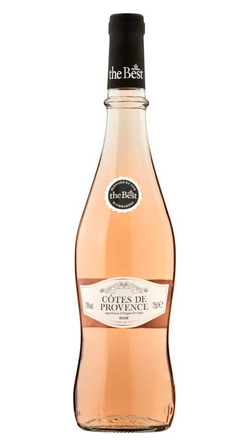
A chilled glass of Côtes de Provence rosé will go perfectly with your salad.
Buy a bottle of Côtes de Provence rosé wine on Amazon (affiliate link).
The stage starts in Monaco.

Monaco is a sunny place for shady people - boom!
It's a Principality east of Nice on the Mediterranean coast with a population of around 36,000 people.
It's only 2km square, about the size of Hyde Park.
That's why some of the buildings are tall, to make best use of the available land area. Because of the skyscrapers it's sometimes known as the Hong Kong of Europe.

More surface area has been created by reclaiming land from the sea, and underground space is used for parking, roads and the bus station.
Some of the vehicles in the underground car parks are sports cars: Monaco has the highest number of sports cars per head of population in Europe.
Monaco is an independent state, but since a treaty of 1641 it has had the protection and friendship of France. It is also represented by France in international affairs. Most French laws are applied in Monaco, but they have to be approved by Prince Albert of Monaco first.
The most important French laws which do not apply are those which relate to taxation. Monegasque nationals (about 10,000 people) pay no tax, and non-French residents of Monaco pay no tax. Monaco does not act as a tax haven for French nationals, who must pay taxes to the French government.
The Greeks founded Monaco, calling it Monoikos. Later the Romans took over.
The Genoese Grimaldi family ruled from 1297, when they came here after being forced into exile from Genoa.
The story goes that Monaco was a Genoese possession, but Francesco Grimaldi dressed up as a monk to gain entry to the fortress on the Rock, and once inside he let his soldiers in.
There was an interruption to Grimaldi rule during the French Revolution and subsequent First Empire. French troops seized Monaco in 1793, but it was returned to the Grimaldis in 1814 after the defeat of Napoléon.
Prince Rainier III came to the throne in 1949 and married Grace Kelly in 1956. She was a Philadelphia-born Hollywood actress who made movies including To Catch a Thief.
The Prince and Kelly had three children (Albert, Caroline and Stephanie), but Princess Grace died in a car crash in 1982.
Stephanie had a hit with Ouragan in 1979.

The sights in Monaco town are the Oceanographic Museum, the Cathedral (which contains Grace Kelly's tomb) and the Palace - originally a 13th century Genoese fortress. You can see the changing of the guard at the Palace at 11.55.
In the capital Monte Carlo there's the Casino, built by Charles Garnier in 1863.
Monaco was the poorest state in Europe in the 1850s, but the Casino - owned by the Société des Bains de Mer - transformed its fortunes. The state is a major shareholder in SBM.
It was Charles Deville Wells who broke the bank at Monte Carlo in 1891. Afterwards, they draped the gaming tables in black for 3 days.
There are European Rooms and American Rooms, with different dress codes and where different gambling games are played.
A Formula 1 Grand Prix is held at Monaco each year.

Despite all of the above, unless you're loaded and spending all your time in over-priced restaurants, there's hardly anywhere in Monaco to sit down.
The park (Saint Martin Gardens) near the Oceanographic Museum in Monaco has some benches, but if you dare to step on the grass a pompous policeman will blow his whistle at you even if he is only 3m away.
The start ramp will be set up by the swimming pool at Monaco's Port.

La Piscine is on the circuit of Formula One races in Monaco.
This area is overlooked by le Rocher (the Rock) where the Palace and the Old Town of Monaco stand.
The route takes the riders along the seafront to Monte Carlo, on Route de la Piscine, Avenue John F Kennedy, and Boulevard Louis II. Boulevard Louis runs past the ornate building designed by Charles Garnier that houses the Casino and the Opera.

The race continues on Avenue Princesse Grace (named after Grace Kelly).
The turn-around point is at Larvotto, near the Plage du Pont de Fer.

After retracing their wheel rotations part-way along the seafront, the competitors climb past the Jardins du Café de Paris on the Avenue des Spélugues and Avenue de la Madone, heading for Beausoleil and La Turbie.
This is the start of the official La Turbie climb.
Soon after the climb begins, the riders leave Monaco and re-enter France.
The parcours continues on Boulevard de la République, Avenue de Verdun and Boulevard de la Turbie to Beausoleil.

From Beausoleil the riders head up to the Grande Corniche road.
The three Corniche roads between Monaco and Nice are the Corniche Inférieur (the coastal road), the Moyenne Corniche (the middle one, where Princess Grace was killed) and the Grande Corniche (the highest one).
The Grande Corniche was built by Napoléon on the route of the old Roman Via Julia Augusta. It leads to the village of La Turbie.

La Turbie belonged to Genoa in the Middle Ages. It then alternated between rule by Savoy and by Monaco.
It is best known for the Trophée des Alpes (or Tropaeum Alpium, or Trophy of Augustus), which is a Roman monument celebrating Emporer Augustus' victory over the 45 Alpine tribes.
The Trophée des Alpes was built around 6BC, after military campaigns of 16 to 7BC.
The monument is partially restored. Originally, it was 49m high and had a statue of Augustus as its centrepiece.

The climb is 8.1km at an average 5.6%. The height at the top is 480m after 11.2km raced.
The La Turbie hill climb often featured as a time trial in Paris-Nice, and Sean Kelly won it five times while winning Paris-Nice seven times in a row (1981-88).
From the top of the La Turbie climb the riders drop down to the Moyenne Corniche at the fascinating village of Eze, at a height of 447m after 13.3km of the route.

Eze has been inhabited since 500BC.
The name may come from the Phoenician goddess Isis, or from the Celtic goddess Aesus.
Around 900AD, Saracens or Moors - pirates from North Africa - arrived by sea and entered the village by what is now known as the Moorish gate. They took over Eze and established a look-out post there.
They were chased out of the area in 972 by Guillaume le Libérateur, Count of Provence.
Eze belonged to Savoy from 1388, and became part of France in 1860.
Théodore de Banville said, 'And here is that strange nest of vultures, the little village of Eze, built on the summit of the rock with more rocks for its outskirts. The houses form part of the mountain and are made of the same granite as it'.
The steep Nietzche path leads up to Eze from the seaside.
Nietzche walked up it in the 1880s, and while climbing he wrote the third part of one of his philosophy books, Thus Spake Zarathrustra. He wrote: 'Of Old and New Tables was composed whilst climbing most painfully up from the station to the marvellous Moorish village of Eza, built amidst the rocks. My muscles have always been at their most agile when my creative force is at its strongest'.
I did once try to read Nietsche's book, and I hope he won't mind me saying that it is less of a page-turner than Harry Potter.
Eze is very popular with visitors. There's an Exotic Garden with cactii around the ruins of the castle.

A Medieval Festival is held in Eze each year on the last weekend in July - a chance to test out your trebuchet technique.

Now the competitors start climbing again, back up to the Grande Corniche at the Col d'Eze. This is not a categorised climb.
The ascent is 1.6km at an average 8.1%. The height at the top is 508m and the summit comes after 17.1km raced.
Next the route passes via the Col des Quatre Chemins, and takes the Boulevard de la Corne d'Or through the outskirts of Villefranche-sur-Mer, heading for Nice.


How to Write a Kindle Ebook is a step by step guide to writing and publishing an ebook on Amazon.
It takes you through the process of writing and formatting it using Microsoft Word, then uploading it to Kindle Direct Publishing and selling it on Amazon.
There's advice and guidance at every stage, with examples including screenshots, and tips on how to overcome practical problems you're likely to encounter.
How to Write a Kindle Ebook will be your reliable and trusted companion as you write and publish your own book.
'I find this a really helpful and informative guide to e-book writing and recommend to others' - reviewer on Amazon.
Buy the ebook or the paperback on Amazon.
Villefranche's bay is quite deep, which makes it a good port. It was home to US Navy vessels from 1948 to 1966, and is now the most popular cruise ship port in France.

The riders go past the Port de Nice and around the Colline du Château.

A cannon is fired from the Château every day at noon. Sir Thomas Coventry started this tradition in 1861, because he wanted to remind his wife that it was time to come home for lunch.
The riders head along the seafront on the Quai des Etats-Unis, past Vieux Nice - the little triangle of tightly-packed buildings that make up Old Nice.

They continue along the Promenade des Anglais.

The turn-around point on the Promenade des Anglais is at a monument called Hommage aux Français d'Afrique du Nord.
The riders come back along the Promenade des Anglais past the Musée Masséna.

The Musée Masséna focuses on the art and history of Nice and the Riviera from 1860 (when Nice became part of France) until the end of the Belle Epoque (1914).
'This is a really cool Museum which pulls together the history of Nice in the context of a sumptuous and well furnished House Museum'.
Tripadvisor
Turning their pedals just a few more times before the Tour ends and they can indulge in pizza and beer by their team buses, the competitors go up Avenue Max Gallo to reach the finish line at Place Masséna.
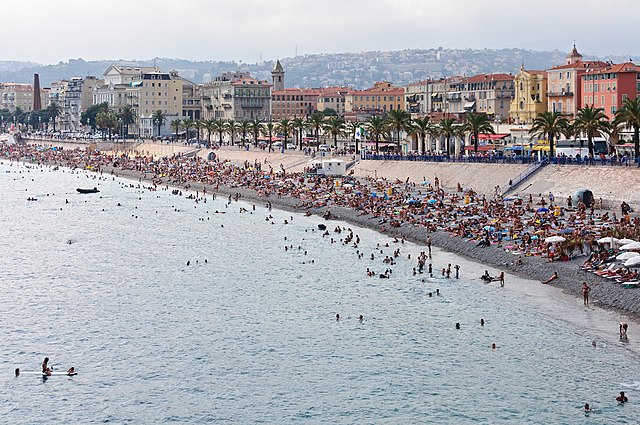
Nice is a major city of around 340,000 people on the Mediterranean coast of France.
This is what one guidebook said about it a few years ago: 'It's a pickpocket's paradise, the traffic is a nightmare, miniature poodles appear to be mandatory, phones are always vandalised, and the beach isn't sand. And yet Nice still manages to be delightful'.
That was in the days when we used paperback guidebooks, and payphones were important, but it's still relevant today. Nice is known as 'Nice la Belle'.
It gets its name from the Greeks, who were the first people to found a colony here, around 600BC. They called it Nikaia, after Nike the goddess of victory.
The Romans took over from the Greeks in 154BC.
Nice was ruled by the House of Savoy from 1388 to 1860. Tobias Smollet visited in 1763.
Tobias Smollet recounted his time in Nice in Travels Through France and Italy.
'When I stand upon the rampart, and look round me, I can scarce help thinking myself enchanted. The small extent of country which I see is all cultivated like a garden. Indeed, the plain presents nothing but gardens, full of green trees, loaded with oranges, lemons, citrons and bergamots, which make a delightful appearance. If you examine them more nearly, you will find plantations of green pease ready to gather; all sorts of sallading, and pot-herbs, in perfection; and plats of roses, carnations, ranunculas, anemonies and daffodils, blowing in full glory with such beauty, vigour and perfume as no flower in England ever exhibited.'
When Nice became part of France in 1860, it really began to develop.
It was the first European city to have a completely tourist-based economy, and between 1860 and 1911 it was the fastest-growing city in Europe.
Queen Victoria went to Nice for the mild Winters, and other English aristocrats followed. Soon it became popular with other European royal families including the Russians.
A railway was built at the end of the 1850s, and the coastal road was extended from Nice to Monaco in 1864. Around the same time, Nice's Opera House was built.
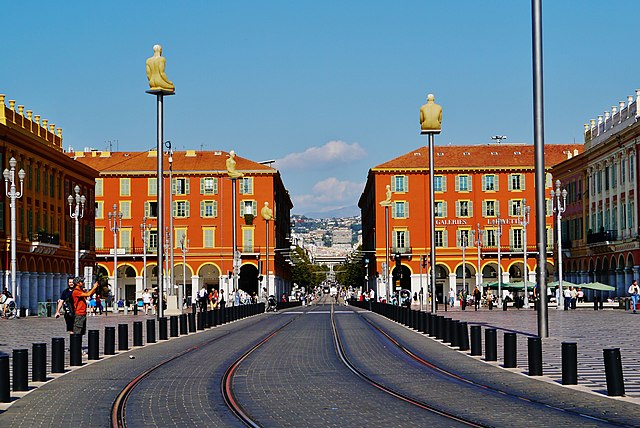
Place Masséna and Avenue Jean Médécin are at the heart of the new town and shopping district.
Masséna was one of Napoléon's generals, and Jean Médécin was a long-serving Mayor of Nice. (Médécin's son Jacques was also Mayor of Nice, but fled to Uruguay in 1990 when he came under suspicion of corrupion; he was extradited, convicted and jailed).
Place Masséna is the largest public square in Nice; the department store Galeries Lafayette is there.
The Promenade des Anglais was built in the 1820s with funds from English residents, and is the place to stroll and admire the Baie des Anges.
The Old Town is an area in the shape of an isoceles triangle under the Château, with narrow streets, small squares, and a Baroque chapel and Cathedral. It hosts a flower market and a fish market.
The Château is a park on a hill overlooking the sea. It is named after a castle built in the 1100s, but destroyed by Louis XIV in 1706. Just the Tour Bellanda remains.
At noon every day a cannon is fired from the Château. Sir Thomas Coventry introduced the practice because he was frustrated by irregular mealtimes.
Nice Carnival features floats with flowers and fruits, and has taken place since 1294.

Remco Evenepoel is a very good time triallist, as is Tadej Pogacar.
Jonas Vingegaard dominated the key mountain time trial in the Alps at the 2023 Tour de France. If he were in top form in 2024 he would probably be the favourite to win, but after his Basque Country crash left him short of preparation time is it impossible for him to reach his best level?
Who do you think will win Stage 21 of the 2024 Tour de France in Nice?

Coldplay 4 CD Catalogue Set, price £15.99 from Amazon at the time of writing (affiliate link).
As an Amazon Associate, I can theoretically earn a small commission from qualifying purchases.
New in 2023, Bike Rides in the Yorkshire Dales is available in colour paperback.
Find out more about Bike Rides in the Yorkshire Dales or buy a copy.
Bike Rides In and Around York features a historical city tour, plus family rides, road rides, and mountain bike rides.
Find out more about Bike Rides In and Around York or buy a copy.
Bike Rides in Harrogate and Nidderdale is a book of family, mountain and road bike rides.
Find out more about Bike Rides in Harrogate and Nidderdale or buy a copy.
Find out more about Mountain Bike Rides in the Yorkshire Dales.
Buy Mountain Bike Rides in the Yorkshire Dales at £8 + P&P.
Garmin Edge Explore, £197.99 at the time of writing.
Garmin Edge Explore on Amazon (affiliate link).
Faster by Michael Hutchinson on Amazon (affiliate link).


