Cycling in Yorkshire & Beyond

Cycling in Yorkshire & Beyond

Settle is a market town in the Craven district of North Yorkshire. The population of Settle is 2,714 (2021 census).
It's a popular place with walkers, mountain bikers and motorbike riders.

There are caves in the area around Settle where prehistoric remains have been found, including Victoria Cave (north east of Settle, and east of Langcliffe). It was discovered in 1837, the year of Queen Victoria's Coronation.
It contained animal bones including those of mammoths, hippos, rhinos, elephants and spotted hyenas. Items from the Roman period were found there too, including coins, brooches, and pottery.

The town itself is thought to have been founded by the Angles in the 600s, since 'settle' is the Anglian word for settlement.
Settle's Royal Charter for a market was granted by King Henry III to Henry de Percy, Baron of Topcliffe, in 1249. There's still a market every Tuesday.
Elgar's friend Dr Charles Buck had a house and doctor's surgery in Market Place.


Settle was quite isolated for many years, but industry did develop in the 1700s and 1800s, mostly cotton mills such as Bridge End Mill.
The river Ribble provided power for Settle's mills, and now it is used for Settle Hydro, a micro hydroelectric scheme.


The railway reached Giggleswick in 1847. This was the Bentham Line, which ran from Morecambe and Lancaster in the west to Skipton in the east.
Then the Settle to Carlisle railway was built by the Midland Railway, and completed in 1875.
Midland wanted its own route north to Scotland. This was because it was in dispute with the London & North Western Railway over access to the West Coast Mainline to Scotland.
Midland's link to the mainline was on a branch line via Ingleton to a place called Lowgill, north of Sedbergh.
Midland and LNWR could not agree on arrangements at Ingleton, so LNWR trains stopped at their station at one end of the viaduct, and Midland passengers had to walk about a mile from their station at the other end of the viaduct to change trains.
Eventually, an agreement was reached to attach Midland carriages to LNWR trains at Ingleton, so that passengers did not have to get out and walk. Even then, LNWR behaved in a deliberately obstructive way, for example attaching Midland carriages to slow freight trains.
In the end, Midland's solution was to build its own line to Carlisle.

There was a threat of closure in 1980s, when British Rail decided the cost of renewing the viaducts and tunnels was too high. It was averted in 1989 when the government refused consent for closure.
The Settle-Carlisle line is still used for freight, including by quarries, and by passengers. Passenger numbers have increased greatly since the 1980s, and it is regarded as one of the most picturesque railways in Britain.


Settle is a small town, but attracts a lot of visitors in the warmer months. The Town Hall (pictured above) also serves as the tourist information.

The Olde Naked Man is one of the best-known cafés in Settle. It dates back to 1663, which makes it perhaps the second-oldest café in England after the Grand Café, Oxford (1650).
The Nettle, formerly the Singing Kettle, is a café, restaurant and bar.

The 3 Peaks Bike Shop is located in Market Place Settle, and has a café.


The Folly was built in 1679 for wealthy lawyer Richard Preston. It houses the Museum of North Craven Life.
It is a grand house.

The Gallery on the Green is an art gallery in a phone box.

There are quite a few independent shops in Settle. They include a hardware shop in Market Place.

Trevor has a Market Shop.

And there's a barber.


Among the religious buildings in Settle is the Parish Church (1838), dedicated to the Holy Ascension.
It has an extensive graveyard, and a number of navvies who worked on the Settle to Carlisle Railway are buried there, some in unmarked graves.
There's also a Quaker Meeting House on Kirkgate, which dates back to 1678.

Settle Stories runs the Yorkshire Festival of Story. It began in 2010, and has become increasingly popular.

Settle Flowerpot Festival runs from mid-July to early September. Characters made out of flowerpots are displayed all around the town.
It's free, but you can buy a Flowerpot Trail & Quiz leaflet.

There are also Flowerpot Workshops for children (must be pre-booked).

The Flowerpot Festival is fun for families.

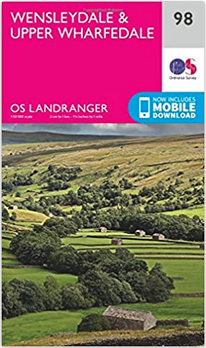
Clapham Loop ride is on the 1:50,000 OS Landranger map number 98, Wensleydale and Upper Wharfedale.

Bike Rides in the Yorkshire Dales is available in colour paperback.
Find out more about Bike Rides in the Yorkshire Dales or buy a copy.
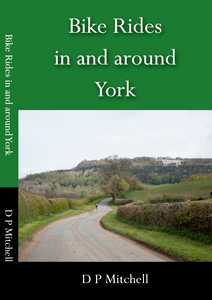
Bike Rides In and Around York features a historical city tour, plus family rides, road rides, and mountain bike rides.
Find out more about Bike Rides In and Around York or buy a copy.
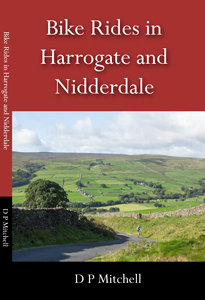
Bike Rides in Harrogate and Nidderdale is a book of family, mountain and road bike rides.
Find out more about Bike Rides in Harrogate and Nidderdale or buy a copy.
As an Amazon associate I earn from qualifying purchases.