Cycling in Yorkshire & Beyond

Cycling in Yorkshire & Beyond
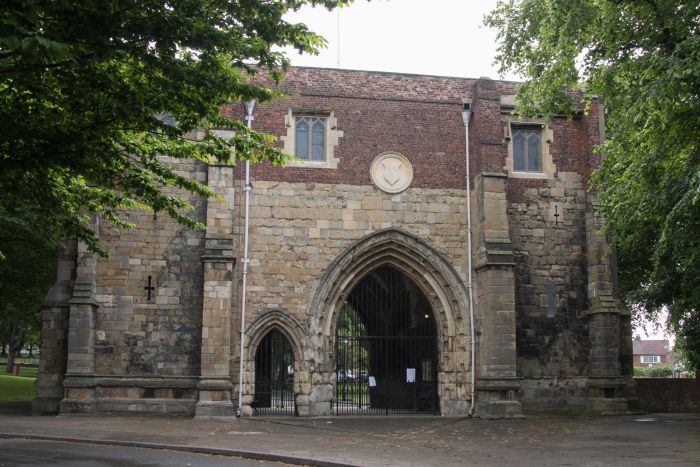
The history here is based largely on David and Susan Neave's 'Bridlington - An Introduction to its History and Buildings'.
Until the 1800s, Bridlington was really two separate settlements - the Old Town and the Quay.
There was almost certainly a Roman port at the mouth of the Gypsey Race, where the current Bridlington harbour stands at the Quay.
Bridlington Bay is thought to be Ptolemy's Safehaven Bay.
No remains of a Roman port can be found because of coastal erosion; the coastline was a mile or so further east at that time.
There are two possible Roman roads to Bridlington, one along the line of Woldgate, and the other a bit further north in the valley of the Gypsey Race (through Grindale, Burton Fleming, Wold Newton etc).
The roads would have linked Bridlington to York and Malton.
Roman villas have been found at Rudston, Harpham and Grindale.
In the late 300s, the Romans built a series of fortified signal stations, and one of them may have been at Flamborough Head.
Danes Dyke is a massive earthwork that separates Bridlington from the Flamborough Head peninsula.
While some archaeologists have argued that it is Bronze Age or Iron Age, it most likely from the Anglian period.
There is also a major pagan cemetery at Sewerby from this time (late 400s onwards).
The name Bridlington is Anglo-Saxon too: Berhtel, a personal name, plus ington, a farmstead.
The Domesday Book records who held land at Bridlington at the time of the Norman invasion, 1066, and who held it at the time of the Domesday Book, 1086.
In 1066, land was held by three Anglo-Scandinavians:
In 1068 and 1071, Morcar rebelled against William of Normandy and forfeited his lands.
In 1086, William had the lands of Morcar and Carle, and William's half-brother Robert held Torchil's manor.

Soon after the Domesday Book was compiled, the royal manor of Bridlington was granted to one of William's comrades-in-arms, Gibert de Gant. He was from Flanders, specifically Ghent.
When G de G died in 1095 the manor went to his son, Walter de Gant.
In 1113, at the request and with the consent of King Henry I, Walter established Bridlington Priory. Walter gave the priory his land at Bridlington, including churches and mills. The churches paid tithes.
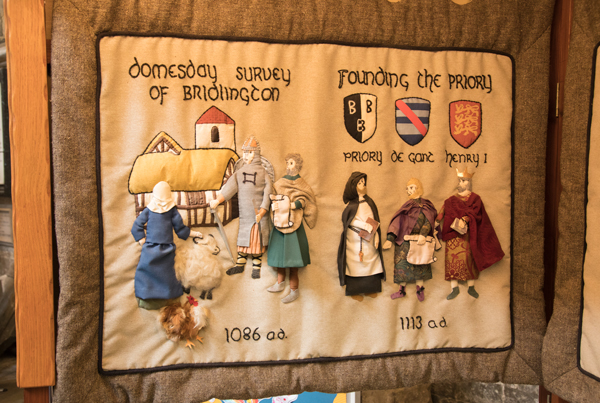
It was a priory of regular canons under the Rule of Saint Augustine, an order especially favoured by Henry and his wife Matilda.
Walter died in 1139 and was succeeded by his son Gibert de Gant, who had been born and raised at Bridlington Priory.
G de G junior quarrelled with his neighbour William of Aumale, Lord of Holderness. William attacked Bridlington Priory, turned the canons out, and fortified the monastic buildings as a castle.
The canons were soon restored to the priory.
There was a great priory barn where produce was gathered in. Corn was ground in the priory's mills and sold at weekly markets and annual fairs: from 1200, the priory could hold its own weekly market and annual fair (14th-15th August); in 1446, three more fairs were granted, in May, September and October.

Information about daily life at the priory is given by Robert the Scribe, third Prior of Bridlington in the mid-1100s. It was organised around seven services in the choir which were:
Around these services the canons would do work such as gardening, agricultural labour, or mending clothes or baskets.
There was also academic work, and Bridlington had a reputation as a centre of learning.
As well as Robert the Scribe and St John of Bridlington, there was chronicler Peter de Langtoft. Also, an unknown author from Bridlington Priory wrote a Life of King Edward II.
The alchemist George Ripley was canon at Bridlington in the 1400s.
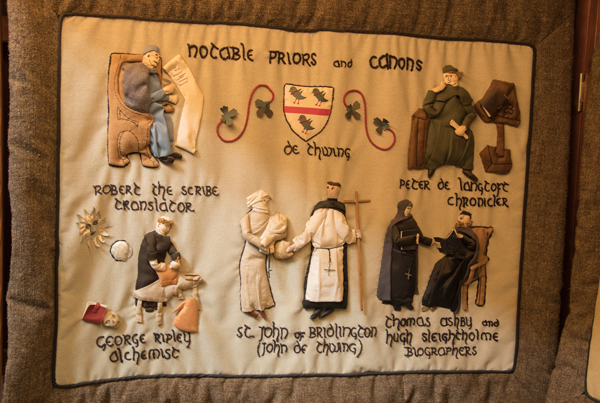
Bridlington Priory dominated the rest of the community here, which was small and chiefly agricultural.

St John of Bridlington (1320-1379) was originally John de Thweng - from Thwing, 9 miles west of Bridlington.
He studied at Oxford then entered Bridlington Priory. He was made Prior in 1363.
He was known for his humility, learning and holiness, and he despised worldly pomp. He was a monastic reformer who insisted on simplicity, equality, abstinence and prayer.
Instead of using the Prior's Chamber, he slept in a cell in the common dormitory. His bedding and clothing were cheap and coarse but decent.
His many miracles during his lifetime included:
After his death, he was responsible for more miracles:
He was made a saint in 1401, and his feast day was 10th October.
Pilgrims came to his tomb in the priory church, and bequests of gold and silver were made to St John's shrine.
There were royal visits to St John's shrine in 1407 (Henry IV) and 1421 (Henry V). Henry VI owned one of St J's fingers, which he gave to Eton College.
Bridlington Priory became quite rich by 1535 - twice as rich as Rievaulx, but only half as rich as Fountains.

The Pilgrimage of Grace in Autumn 1536 was an uprising in the north of England against Henry VIII, partly in protest at his suppression of the lesser monasteries.
Led by Robert Aske of Aughton the rebels took York, Hull and Pontefract, and advanced to Doncaster where they met the royal army.
A truce was negotiated, but after a short-lived second uprising in 1537, the king took revenge on Aske and the other leaders of the Pilgrimage of Grace.
Prior of Bridlington William Wood was executed on the Knavesmire at York for having supported the uprising, and the priory's Steward Sir Robert Constable was hanged at Hull for having taken part in it.
Bridlington Priory and all its possessions were forfeited to the Crown in May 1537.
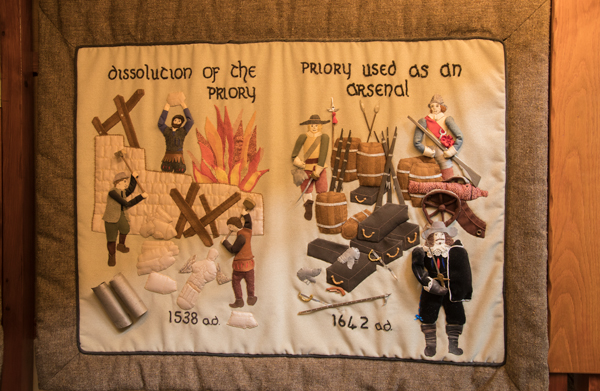
Bridlington Priory was dissolved in 1537, and most of the monastic buildings cleared away - tower, choir, Prior's Hall, cloister, kitchen, dormitory, infirmary, chapter house, library and bakehouse.
The dissolution of Bridlington Priory was carried out by Thomas Howard, Duke of Norfolk. On the instructions of Thomas Cromwell, he destroyed the Shrine of St John of Bridlington.
In March 1538, the priory buildings were stripped of lead and demolished.
The gateway, the Bayle, remains, as does the nave of the priory church. The church was restored by Sir George Gilbert Scott in the Victorian period (1875-6 and 1884).
Most Bridlington people worked within or for the priory, so the
dissolution must have been a blow to them, at least at first.
David and Susan Neave say that once freed from the control of the priory, the town began to prosper.
Malt and corn were the main exports from Bridlington Quay, along the coast and overseas. From the late 1500s, cloth from the West Riding was exported to the Low Countries and the Baltic. Coal and salt were imported from Newcastle and Sunderland in the 1600s.

In 1623 the manor of Bridlington was granted by King James I to Sir George Ramsey, and in 1630 thirteen prominent people of Bridlington clubbed together to buy it.
In 1636, the Great Town Deed was drawn up. Thirteen Lords Feoffees were appointed custodians of the manor and its property.

Henrietta Maria (1609-69) was the daughter of King Henri IV of France and the wife of King Charles I of England.
Just before the outbreak of the English Civil War, in February 1642, she left England for Holland to raise money and hire troops for the Royalist cause.
The war began in August 1642, and in January 1643 Henrietta Maria attempted to return to England only to be caught in a gale.
In February 1643 her convoy tried again, heading for Scarborough. Due to a strong north wind, the ships ended up in Bridlington Bay (20th February 1643).
Commander of the Royalist troops the Earl of Newcastle was at Pocklington, and he sent a detachment to meet the queen. A thousand Royalist horsemen appeared on the beach at Bridlington (22nd Feb).
Four Parliamentary ships sailed in close to the harbour and fired their guns at the Quay (24th Feb); the queen and her ladies in waiting fled from their lodgings - Henrietta Maria going back for her little dog Mitte - and took shelter by the bank of the Gypsey Race.
The Dutch admiral Tromp, who had escorted the convoy, drove the Parliamentary ships away.
The queen went to the Old Town and stayed at a big house on High Street. Arms and ammunition were unloaded from the ships and carried to the the priory to be stored.
Henrietta Maria stayed in Bridlington for two weeks before, on 5th March 1643, she set out for York, later heading on to the Royal capital of Oxford.
A Royalist garrison was left behind at Bridlington, but in February 1644 Parliamentary troops from Hull led by Sir William Constable came along and routed them ('the Battle of Bridlington'). During this period, first Royalist then Parliamentary troops were billeted on the householders at the Old Town and the Quay.
There was money to be made in trade in the 1600s and 1700s. Merchants who owned shares in Bridlington ships prospered, and they built grand houses at the Quay and in the Old Town.
Fishing boats used the harbour too.
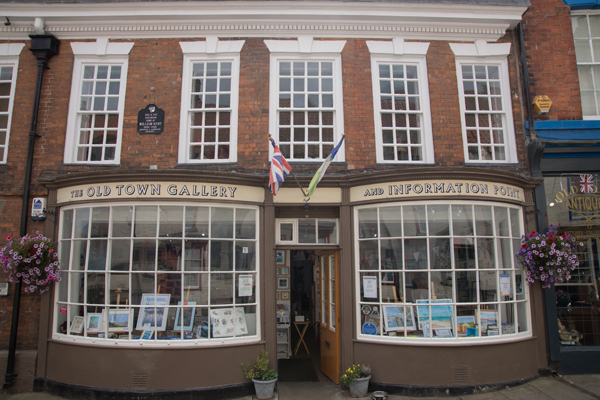
William Kent is described by the Neaves as Bridlington's most famous son. He was an architect and designer of furniture, interiors and landscapes.
He went to London, then spent ten years in Italy. On his return he became a member of the Earl of Burlington's court, and he received commissions from the king and other members of the royal court.
He originated the English 'natural' style of landscape garden.
This naval battle took place within sight of Bridlington during the American War of Independence.
Scotsman John Paul Jones had been commissioned by the US government to harass English shipping. His ship Bonhomme Richard, and others in his squadron, took on HMS Serapis of the Royal Navy, commanded by Captain Richard Pearson. Pearson was escorting 41 English merchant ships.
Jones advanced on the convoy and shots were fired. Over 100 men were killed and both the Bonhomme Richard and the Serapis were damaged. An explosion wrecked the gundeck of the Serapis, and Pearson had to surrender.
Jones took over the Serapis; the Bonhomme Richard eventually sank.
'The cliffs were thronged with spectators and the Quay was in an indescribable state of pandemonium'.

Bridlington began to develop as a holiday resort in the 1760s as part of 'the rush to the sea' - the fashion for sea bathing.
A 1765 advert which appeared in the York Courant was titled 'Bathing Houses at Bridlington' and said:
'Complaint having been made for some time of the want of conveniences at Bridlington for bathing, and of the roughness of the shore on the North Sands; this is to acquaint gentlemen and ladies who require sea-bathing that commodious houses drawn by horses, and all other accommodations as at Scarborough, are now completed and ready for their reception, and a convenient road made for carriages to go down to the South Sands, which are as firm and free from stones as any sands in England'.
The following year, the landlord of the Ship Inn at the Quay built Assembly Rooms.
Bridlington soon became the resort preferred by the landed gentry of the East Riding. Activities included bathing, walking on the sands, taking tea, playing cards, dancing in the Assembly Rooms, and going to the theatre.
From 1805, William Smedley's company put on performances at the theatre in Rope Walk.
The railway came to Bridlington in 1846, with an opening ceremony of the line between Hull and Bridlington on 6th October 1846.
A special train with three locomotives and 66 carriages travelled from Hull to Bridlington. When the first train arrived from Hull around 1pm, there were 'several rounds of applause'.
A lunch was put on in the station goods shed, presided over by George Hudson. Hudson said he hoped the railway would be:
'the means of extending the commerce of that district, and above all that it would be the means of conveying thousands to that place so that its invigorating breezes might confer on them renewed health'.
The day in Bridlington ended with a firework display.
A year later, the railway was extended north to Filey and Scarborough.
There were excursion trains for day-trippers on work or Sunday Schools outings. In 1847, a special train with 35 carriages was put on for 98 teachers and 622 Sunday School children.
According to contemporary reports, many day-trippers were from Sheffield, Leeds, York and Hull, and some of them were 'of the rougher sort'.
In A Month in Yorkshire (1858), Walter White said:
'Bridlington attracts numbers of that class of visitors for whom Hornsea is too quiet and Scarborough too gay'.
Visitors stayed in hotels, inns or lodging houses.
The high point for visits to Bridlington by rail was before World War I. In 1896, 314,484 tickets were collected at the station.
Statue hirings still took place at Martinmas (November). Workers would spend some of their annual wages on clothes and entertainment.
The day could often be riotous, and the Bridlington Free Press described the 1872 event as 'this annual evil...this barbarous and soul-endangering system'.
Coble owners offered 'trips round the bay' in the 1800s.
From the 1840s, there were paddle steamers plying the waters between Bridlington and Scarborough.
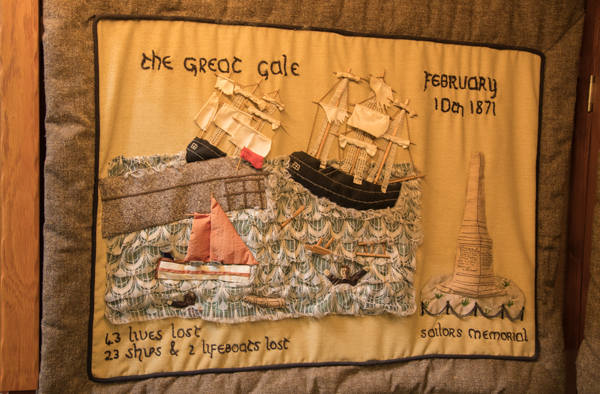
On Friday 10th February 1871, the Great Gale blew.
Harrowing scenes occurred in front of the harbour and the north and south shore, with hundreds of people looking on.
Thirty ships were wrecked and at least 70 people drowned.
The town's two lifeboats rescued many people, but one of the lifeboats overturned (the Harbinger), and six of the nine crew were drowned.
On 14th February, a huge procession went from the Quay to the Old Town, with 4,000 people watching, and the funeral of 23 of the drowned took place at the Priory.
A monument was put up in the churchyard. Every February, a memorial service is held at Bridlington Priory for those lost in the Great Gale.
In 1896, the New Spa was built on the sea front south of the harbour. It had gardens, a lake, a theatre and concert hall, a band stand, and refreshment rooms. (The present Spa building dates from 1932).
In 1904, the Floral Pavilion was built north of the harbour.
The beaches have long been key attractions of Bridlington. In the 1880s, John Browne wrote:
'To what place are the thoughts and desires of the great mass of visitors turned the first thing every morning? To the Sands! To the Sands! The merry, pleasant Sands. Such beautiful sands as we have are not to be found at any other watering place'.
In 1900, Bridlington Corporation allowed, and charged fees for, these stalls on the beach:
Donkeys were present several years before they were officially permitted and licensed in 1896.
World War I affected Bridlington primarily through loss of visitors - both day-trippers and those staying for a week or two.
Hotels and boarding houses were requisitioned for military use, and parts of the beaches were used for training exercises, including digging trenches.
German airships passed overhead in March 1916 on their way to bomb Hull.
The end of the war in July 1919 was celebrated with a Historic Review, or Peace Pageant, devised by the art master at Bridlington Grammar School, Robert Horspool.
Local people dressed up as characters from Bridlington's past; when the procession ended at High Green, there was an Old World Fair, with archery, skittles, bowls, quarter staff and other traditional games, followed by dancing.
Bridlington Augustinian Society was set up to capitalise on the enthusiasm for the study of history.
In the inter-war years, Bridlington's popularity as a holiday resort picked up again.
As well as camping, some people stayed in converted railway carriages or buses, ex-army huts, or wooden bungalows.
The Expanse Hotel was built in 1937.
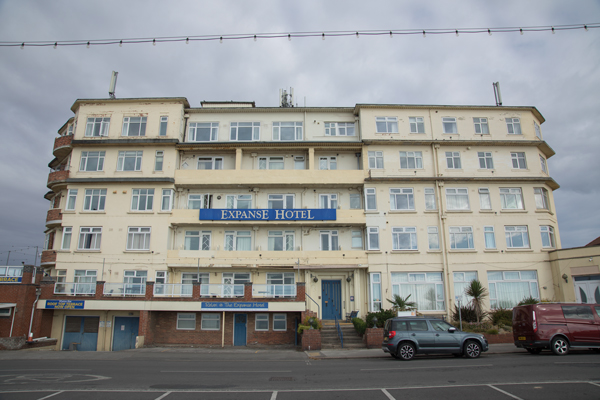
It kept going as a hotel until 2025.
'Professor' Gautier had swimming baths near the harbour, in Queen's Square, and he gave exhibitions each day.
Visitor numbers to Bridlington fell quickly at the start of World War II.
The resort was bombed several times in 1940 and 1941, and on one occasion the pleasure boat Royal Britannia was destroyed in the harbour.
Evacuees were sent to Bridlington. Perhaps some of them attended the war-time cookery demonstrations advertised on a poster that is reproduced in David and Susan Neave's book:
'FOOD is a MUNITION OF WAR. Learn to make the most of your food by attending WAR-TIME COOKERY DEMONSTRATIONS to be held in the Gas Showroom, Quay Road. DEMONSTRATOR FROM THE MINISTRY OF FOOD ADVICE CENTRE. ADMISSION FREE. EVERYONE INVITED'
There was a total blackout at night throughout the war, and a 10pm to 6am curfew for some of it.
Soldiers were billeted in hotels, boarding houses, and at the Spa. Airmen from East Yorkshire bases came into town in the evening.
Tourism resumed after World War II. Concerts began again at the Floral Pavilion and the Spa.
The 1950s have been described as 'the last golden decade of domestic seaside resorts'. From the 1960s, holidays abroad became more common, and there was a higher proportion of low-spend day-trippers.
The collapse of traditional industry in West and South Yorkshire, and in Scotland, reduced visitor numbers.
Fishing increased, and in 1987 Bridlington was the seventh-largest fishing port in England & Wales. In A History of Fishing in Bridlington, Independent Shellfish say:
'By that time, declining fishing stocks were a problem, as was the legislation designed to protect them'.
In other words, 'we've taken all the fish and destroyed marine habitats with our trawling, why are you passing laws to stop us carrying on with business as usual?'
Local fishermen switched to focus on lobster, crab and other shellfish, and Bridlington now calls itself the Lobster Capital of Europe.
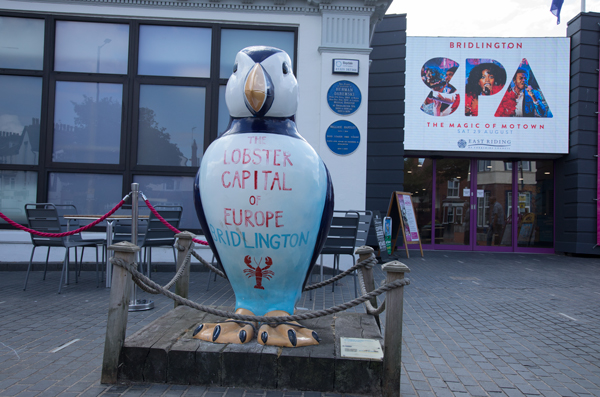
In recent years, English seaside towns have suffered, and efforts have been made to regenerate Bridlington.

Bike Rides in the Yorkshire Dales is available in colour paperback.
Find out more about Bike Rides in the Yorkshire Dales or buy a copy.
Bike Rides In and Around York features a historical city tour, plus family rides, road rides, and mountain bike rides.
Find out more about Bike Rides In and Around York or buy a copy.
Bike Rides in Harrogate and Nidderdale is a book of family, mountain and road bike rides.
Find out more about Bike Rides in Harrogate and Nidderdale or buy a copy.
As an Amazon associate I earn from qualifying purchases.